You want the look of pavers without the maintenance. That is the honest reason most Tampa Bay homeowners call us about stamped concrete. No weeds creeping up between stones. No corners settling after a wet summer. No barefoot stubs on uneven joints next to the pool.
We have been pouring stamped concrete across Pinellas and Hillsborough since 2017. Patios in Hyde Park. Pool decks in Snell Isle. Driveways in Westchase. Long curving walkways in Tierra Verde that have to look intentional from the street. This guide is the same conversation we have with homeowners on the first site visit, written out so you can read it before you call.
We will cover what stamped concrete actually is, the 12 patterns we pour the most in Tampa Bay, real installed pricing, where stamped beats pavers, where pavers beat stamped, and the single decision that determines whether your slab still looks new in year seven or starts peeling in year two. That decision is the sealer.
What stamped concrete actually is
Stamped concrete is poured concrete with three extra steps. First, color is mixed into the wet slab or broadcast on top as a hardener. Second, a release agent goes down so the stamp does not stick. Third, large rubber texture mats get pressed into the surface while the concrete is still workable, imprinting the pattern of stone, brick, wood, or whatever look you chose.
Once cured it is one continuous slab. No joints to fill. No individual stones to settle. The pattern is in the concrete itself, not glued on top.
People sometimes confuse stamped concrete with stained concrete or with thin overlays. Stained is just color on an existing slab. Overlays are a thin layer of material poured over old concrete to stamp into. Both have their place, but a true stamped pour is the full thickness of concrete done correctly the first time. That is what lasts.
The 12 most popular stamp patterns in Tampa Bay
We stock dozens of mats. These twelve are what Tampa Bay homeowners actually choose nine times out of ten.
1. Ashlar slate. The most popular pattern for patios. Rectangular slate-textured stones in a randomized layout. Reads as upscale without being fussy. Hides minor settling cracks better than any other pattern.
2. Roman cobblestone. The go-to for driveways and front walkways. Old-world European look. Pairs beautifully with Mediterranean and Tuscan-style homes common in South Tampa and Belleair.
3. Italian slate. A finer, more refined slate texture. Almost always our recommendation for pool decks because the surface stays smooth enough for bare feet.
4. Random stone, also called fieldstone. Irregular, organic shapes. Great for backyard patios that want to feel natural rather than formal. Works well around fire pits and outdoor kitchens.
5. European fan. Small cobbles laid in a fan or arc pattern. Adds Old World charm to courtyards and entry walkways. We pour a lot of these in Davis Islands and Hyde Park.
6. Brick herringbone. Classic. Disciplined. Reads as traditional. Pairs with Colonial and Cape Cod-style homes.
7. Brick running bond. The simplest brick layout. Long parallel rows. Clean. Cost effective if you want a brick look without the busier herringbone visual.
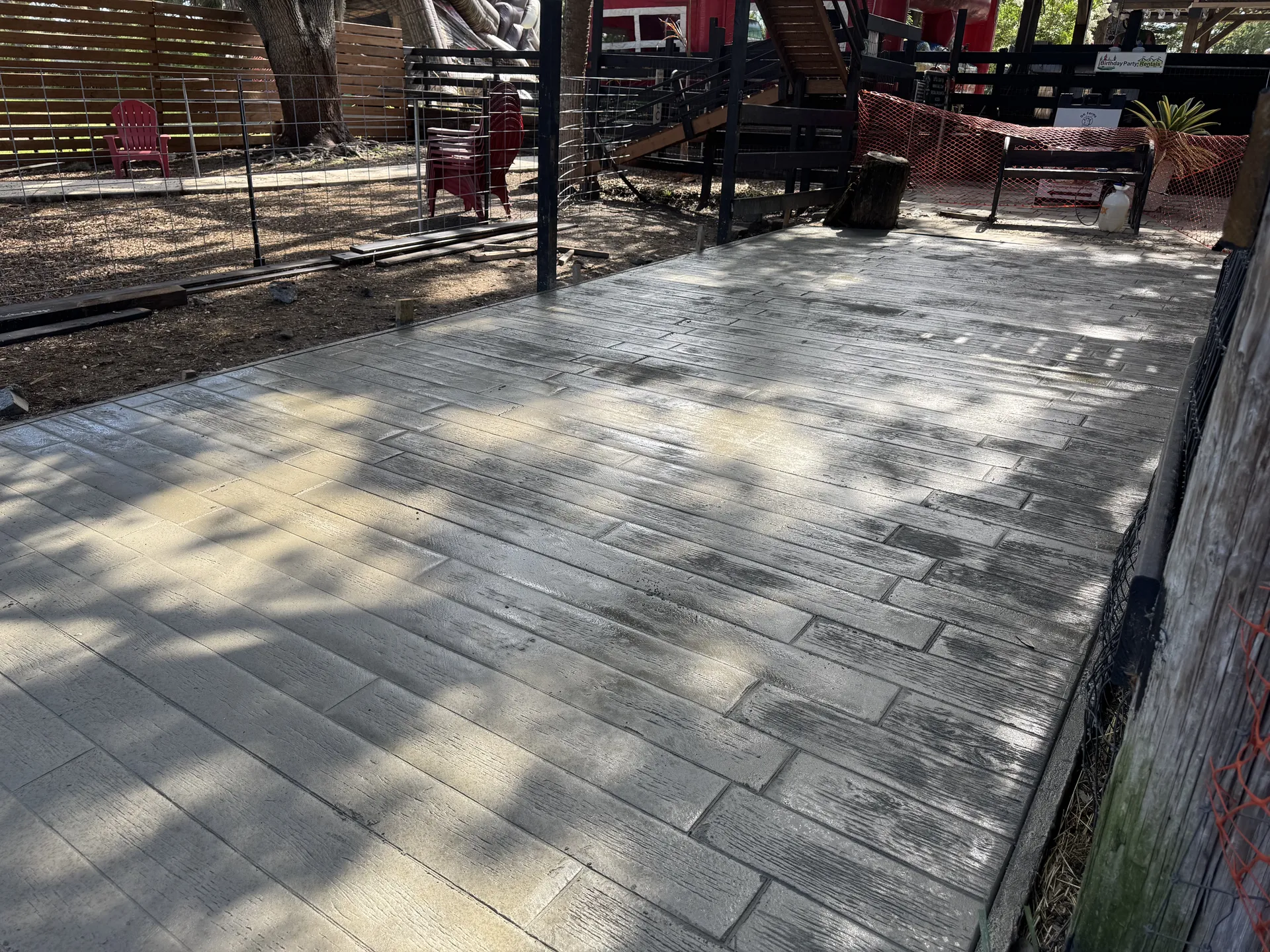
8. Wood plank, sometimes called weathered wood. Stamped to look like reclaimed barn wood planks. Very popular for back patios attached to modern farmhouse exteriors. Looks shockingly real when colored right.
9. Travertine. Soft, tumbled travertine tile texture. A favorite for pool deck construction because it suggests the real travertine that gets installed on high-end pools, at a fraction of the cost and with none of the loose-tile failure risk.
10. Flagstone. Large, irregular flat stones with deep joints. Good for sloped walkways and pool surrounds where you want a more rugged, naturalistic feel.
11. Coquina shell. A Florida-specific pattern that mimics the crushed-shell coquina stone you see in old St. Augustine architecture. Coastal. Unique. We pour it for waterfront homes in Tierra Verde and along the Gulf coast where homeowners want something distinctly Florida.
12. Custom borders and medallions. Any of the above can be combined. Ashlar slate field with a Roman cobblestone border. A compass rose medallion at the center of a circular patio. House initials at the front entry. This is where stamped concrete stops being a product and starts being design.
Pricing, what to expect in Tampa Bay
Real numbers. These are our 2026 installed prices for Pinellas and Hillsborough. They assume reasonable site access and a properly prepared subgrade. Demolition of existing concrete, drainage work, and structural reinforcement for vehicle traffic are separate line items.
- Basic single-color stamp: $14 to $18 per square foot installed. One integral color, one stamp pattern, one sealer coat.
- Two-color with release agent: $18 to $22 per square foot. Base color plus an antiquing release that settles into the texture and adds depth. This is what most people picture when they imagine stamped concrete done right.
- Custom borders and medallions: $22 to $30 per square foot for the detailed sections. Field area is priced at the base rate, with the custom work added on for the perimeter or feature zones.
- Resurfacing an existing slab with stamped overlay: $8 to $14 per square foot. Cheaper because we are not pouring new concrete, but only viable if the existing slab is structurally sound and free of major cracks.
For a typical 500 square foot patio, expect $7,000 to $11,000 for a standard two-color stamp and $11,000 to $15,000-plus for premium work with borders or medallions. A 700 to 900 square foot pool deck usually lands between $13,000 and $20,000 depending on complexity.
A pricing tip from us. Be wary of any Tampa Bay contractor quoting under $12 per square foot for stamped work. At that price something is getting cut. Usually it is the slab thickness, the rebar, or the sealer quality. You will pay the difference in repairs by year three.
Where stamped concrete wins versus pavers
We install both. We are not religious about either one. Here is the honest case for stamped.
No joints means no weeds. Pavers have sand-filled joints. In Florida that sand washes out, weeds find their way up, and you spend Saturdays with a wire brush and weed killer. Stamped is one continuous surface. Nothing to weed.
No individual stones means no settling. When pavers settle, they settle unevenly. One stone drops a quarter inch and you have a trip hazard and a puddle. Stamped concrete settles as a slab if it settles at all, and proper subgrade prep makes that rare.
Lower lifetime maintenance. Pavers need re-leveling, re-sanding, sometimes individual replacements. Stamped needs sealer every three to five years and a hose-down. That is it.
Smooth for bare feet around a pool. This matters more than people expect. Paver joints catch toes. A properly poured Italian slate or travertine stamp gives you texture for slip resistance without any sharp edges.
Faster install. A 500 square foot stamped patio is usually a one-week job from form to seal. The same square footage in pavers can take two weeks once you account for base prep, individual stone laying, cutting, and polymeric sand.
Where pavers win
Two real situations where we tell homeowners to go with pavers instead.
You expect to make changes. If you are putting in a patio now but might add a pool, a screen enclosure footer, or a utility trench in three years, pavers can be lifted out and put back. Stamped concrete cannot. We have cut into beautiful stamped patios to run a gas line and the repair was never invisible.
Soil instability you cannot fix. Some lots in Tampa Bay have unstable fill or high water tables that make slab settling more likely. Pavers tolerate minor movement. A stamped slab will crack along that movement. If the engineering report on your lot looks rough, pavers are the safer bet.
If either of those applies to you, we will tell you. We would rather lose a stamped quote than install a job that fails in five years and ends up on a review site.
Sealer selection in Florida, the make-or-break decision
This is the section most stamped concrete articles skip. It is also the single most important variable in how long your patio looks new.
Florida sun does not care how good your concrete is. UV breaks down sealers. Cheap sealer means re-sealing in 18 months. The right sealer, applied right, gets you five to seven years between coats. Maybe more.
Three categories of sealer you will hear about.
Solvent-based acrylic. The traditional choice for stamped patios. Brings out color richness. Gives that wet look people associate with high-end decorative concrete. Reapply every three to five years. Good choice for shaded patios and walkways. We use a high-grade solvent acrylic for most non-pool stamped work.
High-solids urethane. Significantly more abrasion resistant and more UV stable than acrylic. This is what we recommend for pool decks and any high-traffic stamped surface. Holds up against the chlorine plus UV combination that kills acrylics in a couple of seasons. More expensive up front, but it is the right call for pool surrounds and outdoor kitchen floors.
Penetrating densifier. This is not really a topical sealer. It soaks into the slab and chemically hardens the concrete from within. No surface film to peel. Used as a base layer under decorative sealers on premium pours, or as a standalone for industrial and commercial work where you do not want a glossy look.
Avoid water-based acrylic sealer on hot Florida slabs. It looks like a money-saver. It is not. Water-based products do not bond well to a slab that is sitting at 95-plus degrees in summer afternoon sun. They turn cloudy. They peel. We have re-done jobs where the previous contractor used water-based to save $200 and the homeowner paid us to strip and re-seal it the next year.
Avoid stark white pigmentation under any sealer. Florida UV yellows white concrete fast. If you want a light look, go with a warm off-white or a sand tone. They age gracefully.
The install process, week by week
Here is what a typical stamped concrete project looks like from the day you sign to the day you walk on it.
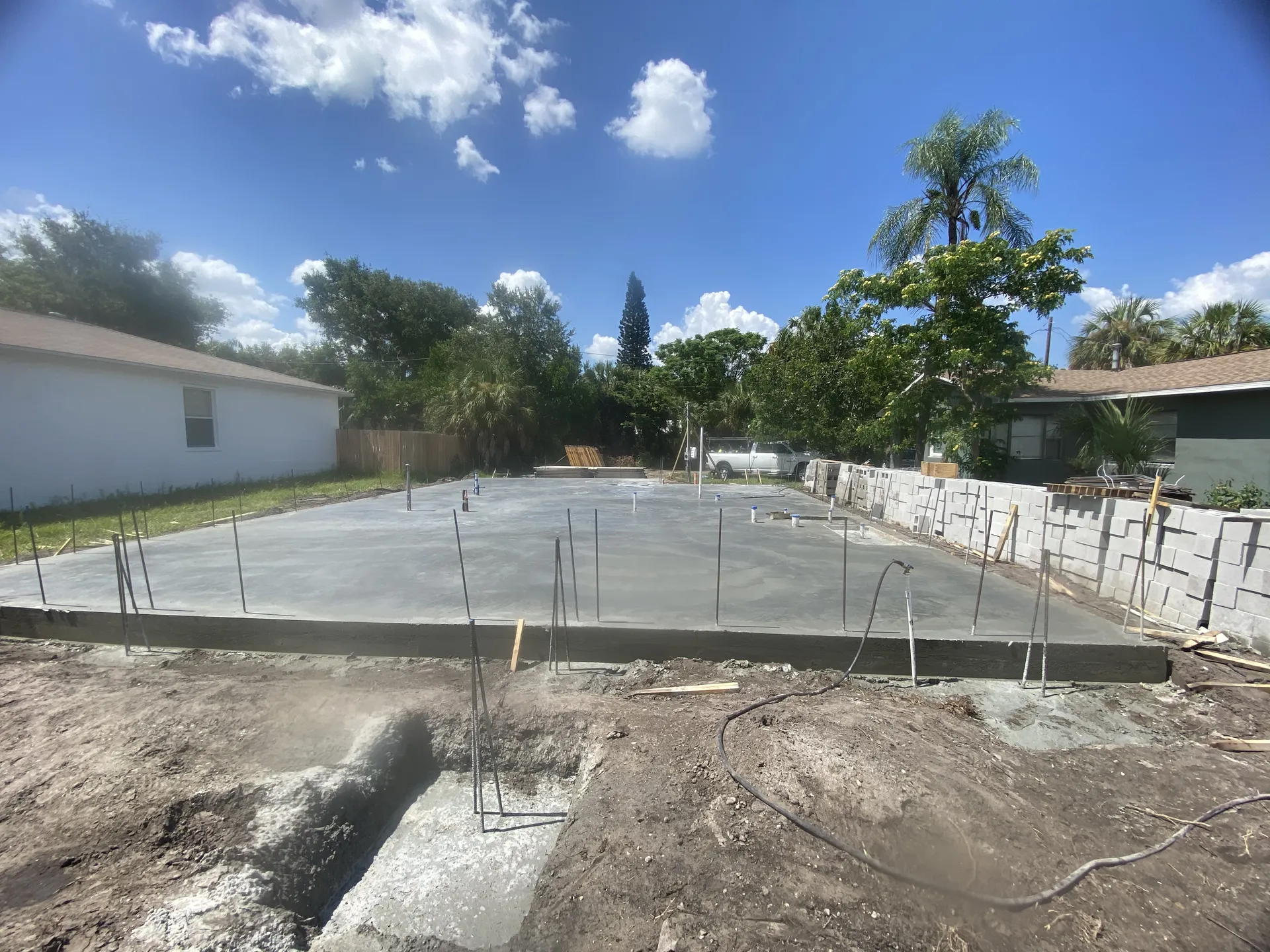
Day 1 and 2. Layout, forming, and subgrade prep. We grade the base, compact it, set forms, and lay rebar or wire mesh. For a patio we also confirm drainage flow away from the house. Florida summer storms test drainage hard.
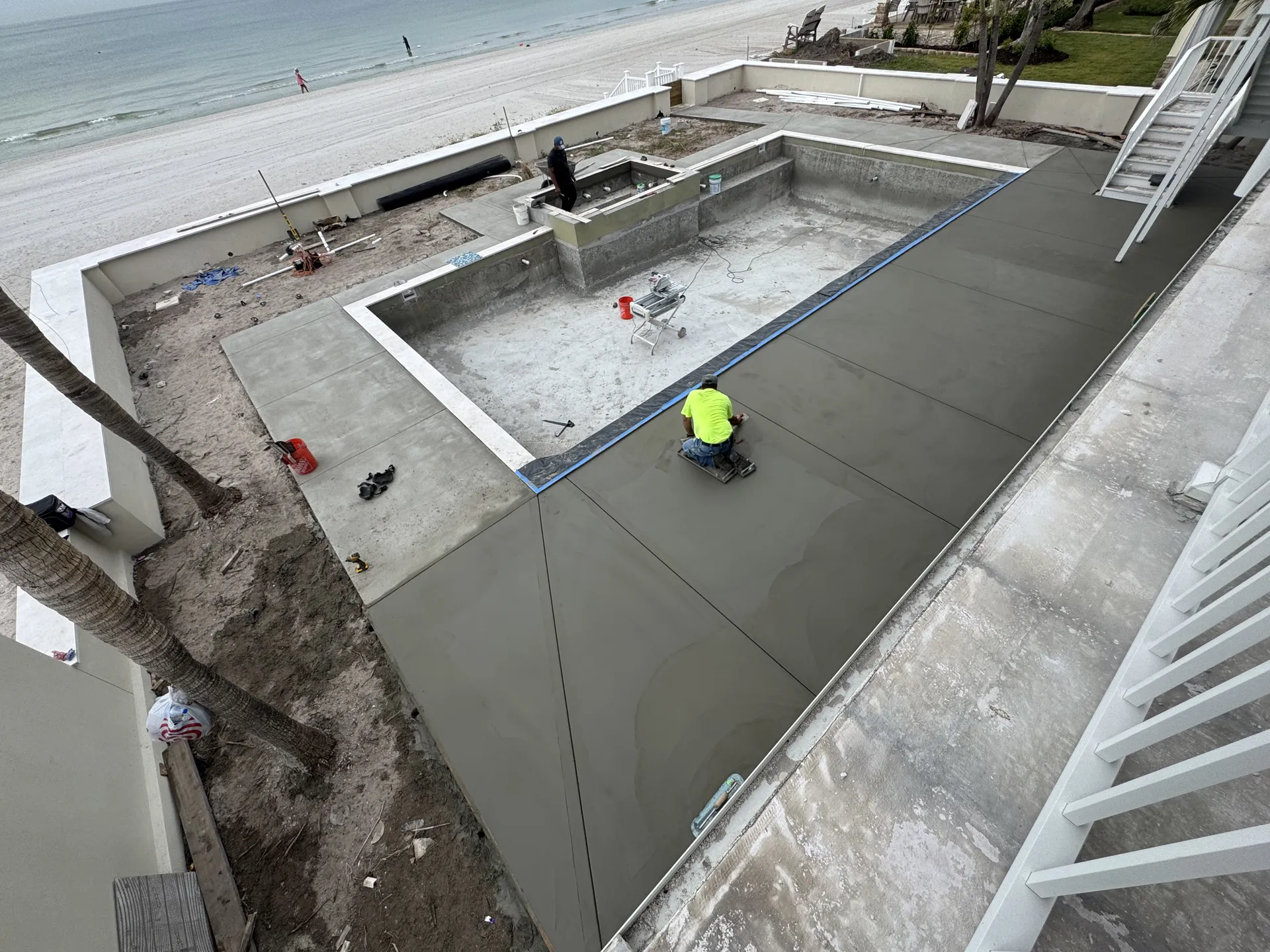
Day 3. Pour day. Concrete trucks arrive early morning to beat the afternoon rain window. We pour, screed, float, broadcast the color hardener, float again, then apply release agent and start stamping while the slab is at the right firmness window. Stamping a 500 square foot patio is a five to six hour crew effort and timing is everything.
Day 4. Detail work. Touching up edges, hand-tooling control joints to match the pattern, washing off excess release agent.
Days 5 through 7. Cure. The slab needs time before sealer goes on. Walking is usually fine after 48 hours. Driving on a stamped driveway should wait a full seven days.
Day 7 to 10. Sealer application, usually two coats with dry time between. We schedule sealer for a low-humidity window if we can. After the second coat sets, the job is done.
Most projects from signed contract to sealed slab run about two weeks. We watch the forecast obsessively. A surprise afternoon downpour on stamp day can ruin a pour, so we build flex into the schedule.
Maintenance schedule, what you actually need to do
Stamped concrete is low maintenance, not no maintenance. Here is the realistic homeowner schedule.
Weekly. Sweep or blow off debris. Hose down if it gets dirty.
Monthly. Mild soap and water on stains. Wine, grease, sunscreen, all the usual patio offenders come up easily if you catch them.
Annually. Walk the slab. Check for hairline cracks at control joints. Check sealer for dull spots. Address anything small before it gets bigger.
Every three to five years. Re-seal. A properly poured slab with a high-solids urethane on a pool deck might stretch to seven. A solvent acrylic patio under partial shade lands closer to four. We offer maintenance re-seals to past clients and it is a fraction of the original install cost.
If you skip the re-seal, the color fades, the surface gets porous, and stains start setting in. The sealer is your warranty against the Florida sun. Keep it fresh.
Color choices that work in Florida
Color is where homeowners freeze up. Too many options, too many sample boards. Here is what actually works over the long haul in Tampa Bay weather.
Warm tans and sand tones. Always a safe choice. Hides dust. Hides the inevitable scuff. Pairs with almost any home color.
Terra cotta and warm browns. Beautiful with Mediterranean and Spanish-style homes. Rich. Aging gracefully because they are already on the warm end of the spectrum.
Gray-blue and slate gray. Modern. Reads cool and upscale. Works well in newer construction neighborhoods like parts of Westchase and Channelside. Be careful with very dark grays, see the next note.
Mocha and coffee tones. Excellent for pool decks because they tie into the water visually. Not as hot underfoot as black or deep charcoal.
Avoid stark white. It yellows under FL UV. We have seen white stamped patios turn dingy within two years even with good sealer.
Avoid very dark colors on barefoot surfaces. Black, deep charcoal, and dark espresso get burning-hot in July. Beautiful in catalog photos. Painful on actual feet. For pool decks, stay on the lighter side. For driveways and front walkways where nobody walks barefoot, dark works fine.
Bring photos of your house. Bring a piece of your roof tile or a paint chip. We pour test samples on site and let you see them in actual Florida sunlight before you commit. Sample boards under fluorescent showroom lights lie.
Ready to talk about your project
If you have a patio, pool deck, walkway, or driveway installation you are thinking about, give us a call. We come out, walk the site, measure, talk through patterns and colors, and write you an honest quote. No high-pressure sales. No same-day-only discounts. If pavers are the better call for your situation, we will say so.
We serve all of Tampa Bay, including Tampa, St. Petersburg, and Clearwater. If you have an existing stamped slab that needs help, we also handle concrete repair and re-seal work for slabs we did not originally pour.
Call Randy and the HR Concrete team at 727-291-9908 or request a Free Estimate online. We answer the phone, we show up when we say we will, and we pour stamped concrete that still looks good when the warranty paperwork is yellowed in a drawer.